
Core for More Bible Study — September 23, 2026
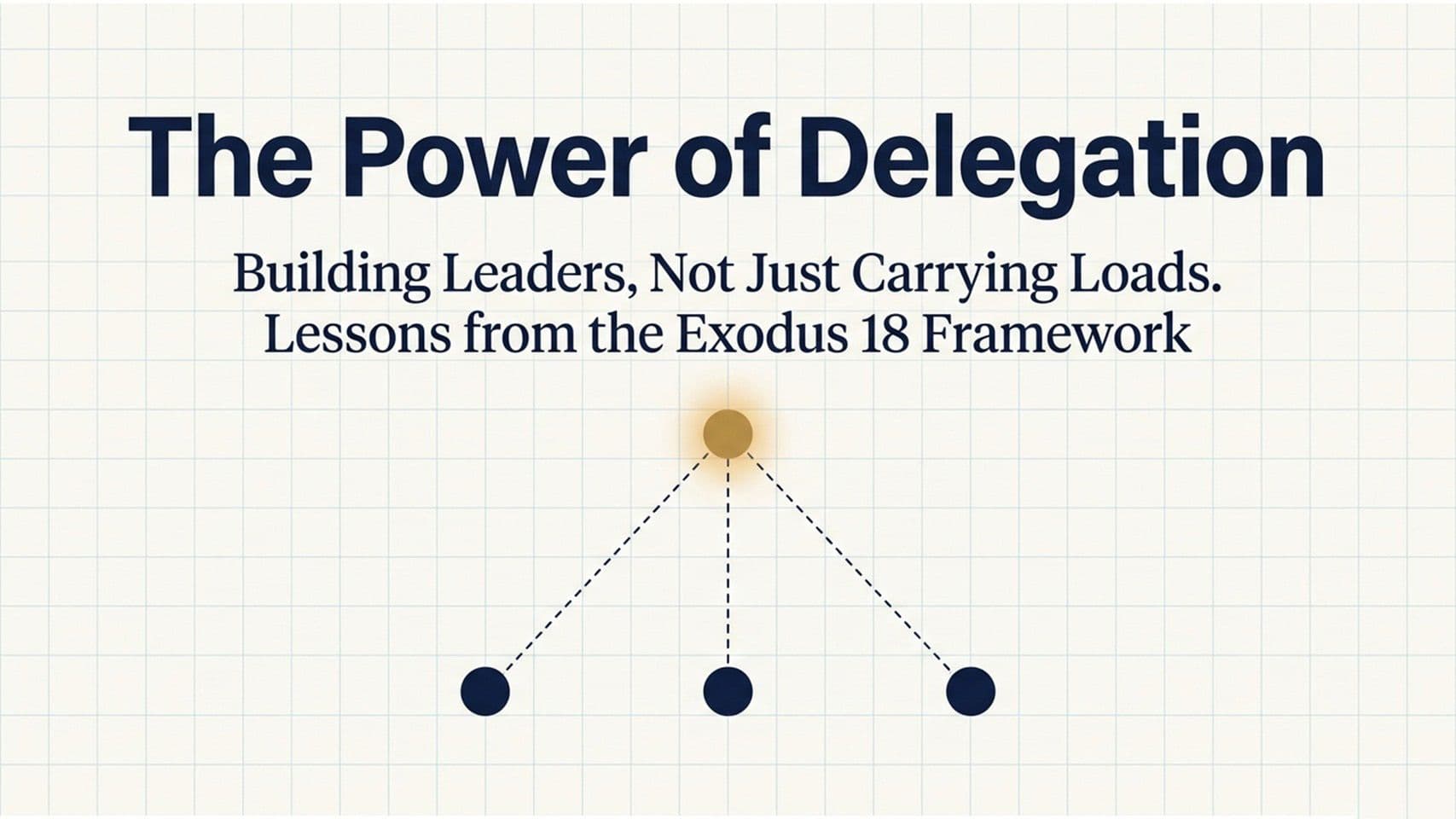
The Power of Delegation: Jethro and Moses: Building Leaders, Not Just Carrying Loads
Main Text: Exodus 18:1–27 (AMP)
Leadership Principle: If you do everything, you limit everything.
Great leaders do not measure their success by how much they personally accomplish. They measure their success by how many people they develop, empower, and equip to accomplish the mission.
Moses was called by God, anointed by God, and chosen to lead Israel. But even a great leader can become overwhelmed when he tries to carry every responsibility alone.
Jethro helped Moses discover a critical leadership truth: Your calling may be bigger than your capacity, but delegation can expand your capacity without diminishing your calling.
1. Great Leaders Can Still Have Poor Systems | Exodus 18:13 (AMP)
"It came about the next day that Moses sat down to judge the people, and the people stood around Moses from morning until evening."
Moses was doing everything:
- Hearing disputes.
- Making decisions.
- Answering questions.
- Solving problems.
- Carrying the responsibility for the entire nation.
Moses was not failing because he lacked commitment. He was struggling because the system depended too heavily on one person.
Leadership Lesson: A growing organization cannot depend on one person's availability, energy, or ability to solve every problem.
The same principle applies to the church. If every decision requires the pastor, every ministry waits for the pastor, and every problem comes to the pastor, growth eventually creates exhaustion.
Leadership Question? What responsibilities are currently dependent on me that could be handled by a trained leader?
2. Your Calling Does Not Require You to Do Everything | Exodus 18:17–18 (AMP)
"Moses' father-in-law said to him, 'The thing that you are doing is not good. You will surely wear out both yourself and these people who are with you, because the task is too heavy for you; you cannot do it alone.'"
Jethro identified two problems:
- Moses was wearing himself out.
- The people were being affected by the system.
This is important: Burnout is not always caused by doing too much work. Sometimes it is caused by refusing to share the work.
Moses had a legitimate responsibility, but he had taken on responsibilities that others could help carry.
Leadership Lesson: You can do good work in an unhealthy way.
A leader can be faithful, sacrificial, and committed while still operating a system that is unsustainable.
Illustration: The One-Person Church
Imagine a church where the pastor must approve every announcement, solve every conflict, oversee every event, answer every question, and personally handle every ministry decision.
The pastor may be gifted, but the church has created a bottleneck.
The goal is not to make the pastor less important. The goal is to make the ministry less dependent on the pastor doing everything.
3. Delegation Is Not Abandonment—It Is Development | Exodus 18:20 (AMP)
"Then you teach them the statutes and the laws, and make them know the way in which they are to walk and the work they are to do."
Jethro did not tell Moses to simply hand people responsibilities and walk away.
He told Moses to teach them.
This is the difference between delegation and dumping.
Delegation vs. Dumping
Dumping
Delegation
"You handle it."
"Let me teach you how to handle it."
No clear expectations.
Clear responsibilities.
No training.
Training and preparation.
No accountability.
Follow-up and evaluation.
Creates frustration.
Develops confidence.
Leadership Lesson:
- You cannot delegate what you have not developed.
- If you want leaders who can carry responsibility, you must invest in their understanding, skills, and judgment.
- A leader who only gives instructions creates followers. A leader who teaches principles develops other leaders.
Church Application:
Instead of saying: "Make sure the event goes well."
Say: "Here is the purpose of the event, the budget, the timeline, the people responsible, and the standard we expect. Let me walk you through how we will evaluate success."
4. The Right People Must Carry the Right Responsibilities | Exodus 18:21 (AMP)
"Furthermore, you shall select out of all the people able men who fear God, men of truth, those who hate dishonest gain; and place these over them as leaders of thousands, of hundreds, of fifties, and of tens."
Jethro gave Moses a leadership structure.
He did not recommend choosing people simply because they were available, popular, or loyal.
He identified character and capability.
Jethro's Four Leadership Qualifications
- Able — They have the capacity to handle responsibility.
- Fear God — They understand that leadership is accountable to God.
- Men of truth — They are trustworthy and honest.
- Hate dishonest gain — They are not motivated by personal advantage.
Leadership Lesson: Never delegate authority based only on friendship. Delegate responsibility based on character, competence, and capacity.
Someone can be a wonderful person and still not be ready for a particular assignment.
The question is not merely, "Do I like them?"
The question is, "Can I trust them with this responsibility, and have I helped prepare them for it?"
5. Build a Structure That Allows Everyone to Contribute | Exodus 18:25 (AMP)
"Moses chose able men out of all Israel and made them heads over the people, leaders of thousands, of hundreds, of fifties, and of tens."
Jethro introduced layers of leadership.
Moses could not personally oversee every person in Israel, but he could develop leaders who could oversee smaller groups.
This is a powerful organizational principle:
The larger the organization becomes, the more important leadership structure becomes.
The Leadership Pyramid:
- Moses: Overall direction and major decisions.
- Leaders of thousands: Oversight of large groups.
- Leaders of hundreds: Oversight of smaller divisions.
- Leaders of fifties: Closer supervision.
- Leaders of tens: Direct, personal leadership.
The structure allowed responsibility to move closer to the people who needed help.
Church Application:
A healthy church may have:
- Senior leadership.
- Executive leadership.
- Ministry directors.
- Ministry leaders.
- Team leaders.
- Volunteers.
The pastor should not be the only person who knows what is happening.
Leadership Question? If our organization doubled in size next year, what part of our current structure would break first?
6. Keep the Responsibilities That Only You Can Carry | Exodus 18:19–20 (AMP)
"You be the people's representative before God, and you bring the disputes before God. You teach them the statutes and the laws..."
Jethro did not tell Moses to delegate everything.
He told Moses to keep the responsibilities that belonged to his unique role.
Moses was still responsible for:
- Representing the people before God.
- Bringing difficult matters before God.
- Teaching God's statutes and laws.
- Providing spiritual direction.
Leadership Lesson: Delegation is not about giving away your purpose. It is about protecting your purpose.
There are things only you can do.
For a pastor, that may include:
- Hearing from God.
- Guarding the vision.
- Teaching the Word.
- Providing spiritual direction.
- Making decisions that require pastoral authority.
But there are many things others can do:
- Organizing events.
- Managing schedules.
- Coordinating volunteers.
- Handling routine questions.
- Leading ministries.
- Developing systems.
The goal is to free the leader to focus on the highest-value responsibilities.
7. Systems Protect the Mission From the Limitations of the Leader | Exodus 18:23 (AMP)
"If you do this thing and God so commands you, then you will be able to endure, and all these people also will go to their place in peace."
Jethro's advice had two outcomes:
- Moses would be able to endure.
- The people would experience peace.
- This is the purpose of a healthy system.
A system is not just paperwork. A system is a repeatable way of accomplishing a responsibility.
A Simple Leadership System
For every recurring responsibility, establish:
- Purpose — Why does this matter?
- Person — Who is responsible?
- Process — How should it be done?
- Performance — What does success look like?
- Progress — How will we evaluate and improve?
Example: Sunday Service
Instead of the pastor personally coordinating every part of Sunday service:
- A service leader oversees the schedule.
- A worship leader oversees music.
- A production leader oversees technology.
- An ushering leader oversees seating.
- A children's leader oversees children's ministry.
- An administrative leader handles logistics.
The pastor remains responsible for the spiritual direction of the service, but the entire service is not dependent on the pastor personally managing every detail.
THE DELEGATION FORMULA
D.E.L.E.G.A.T.E.
D — Define the responsibility
- Be clear about what needs to be accomplished.
E — Establish the standard
- Explain what excellence looks like.
L — Locate the right person
- Choose someone with character and capacity.
E — Equip the leader
- Provide training, tools, and information.
G — Give authority
- Allow the person to make appropriate decisions.
A — Assess progress
- Review results and provide feedback.
T — Trust the process
- Give the leader room to grow without micromanaging.
E — Expand responsibility
- As the leader proves faithful, increase their influence.
Key Thought: Delegation without authority creates frustration. Authority without accountability creates confusion.
Healthy leadership requires both.
The Cost of Refusing to Delegate
When leaders refuse to delegate, several things happen:
- The leader becomes exhausted.
- Moses was working from morning until evening.
- The people become dependent.
- They learn to wait for one person to solve every problem.
- Future leaders remain undeveloped.
- People cannot grow into the responsibility they are never allowed to carry.
- Growth becomes difficult.
- The organization can only move as fast as the leader can personally manage.
- The mission becomes vulnerable.
- If everything depends on one person, the mission is limited by one person's capacity.
- If you do everything, you limit everything.
Final Scripture
Exodus 18:23 (AMP)
"If you do this thing and God so commands you, then you will be able to endure, and all these people also will go to their place in peace."
Leadership Exercise: The Delegation Audit
Ask every leader to make three lists.
List 1: Only I Can Do
- What responsibilities require my unique authority, calling, or expertise?
List 2: Someone Else Can Do
- What responsibilities could another trained person handle?
List 3: Someone Else Can Learn to Do